
Crime statistics in Catalunya are publicly available — but understanding them takes patience. I built this map to make sense of the data: a composite safety index across 12 crime types, mapped by police zone, with trends since 2019 and a comparison against Spain's national average.
Explore all 59
police zones
 Open full screen
Choose a crime type — or select Safety Index against Catalunya or Spain.

Drag the year slider to explore changes between 2019 and 2025.

Select any zone for its crime breakdown and regional and national scores.
This map vs.
the official map
The Mossos d'Esquadra publish detailed crime statistics through the ICGC crime map viewer — a solid resource covering all 59 ABP police zones across Catalunya, with yearly data going back to 2019. There you can filter by crime type, see charts per zone, and compare against the Catalan average. It's a useful starting point, and I used it constantly while building this.
After spending time with it, though, I kept running into the same gaps. There's no composite safety score — you have to click through each crime type one by one, which makes it hard to get an overall feel for a zone. There's no comparison with Spain, only with Catalunya. And spatial trends are invisible: you can pull a chart for a single zone, but not a regional view of which areas are getting better or worse over time.
What the data
revealed
Barcelona averages 2–4× worse than the Spanish national average
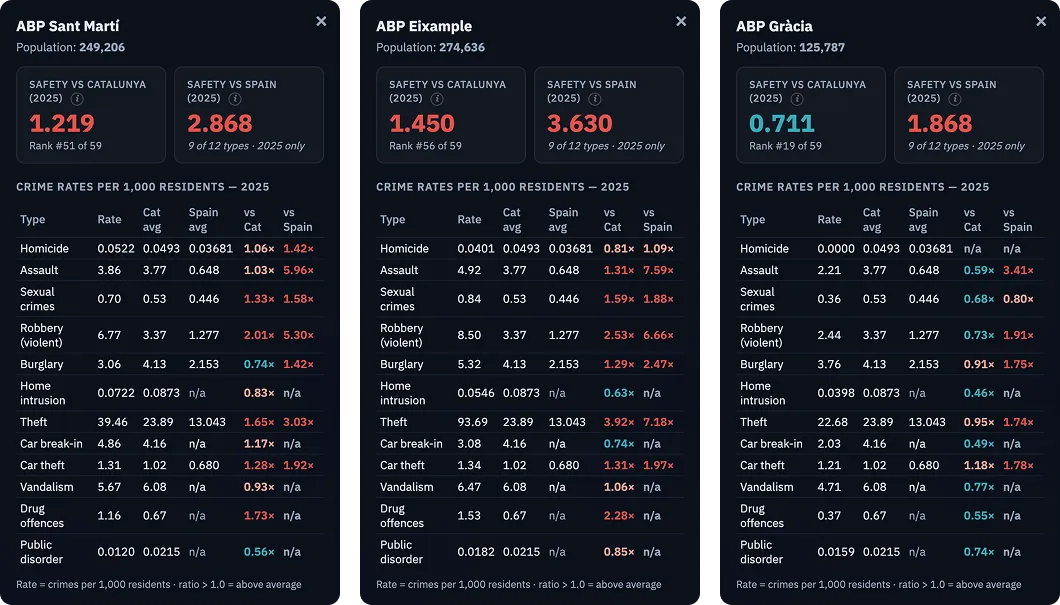
For an average Spanish person relocating to Barcelona, crime rates feel dramatically higher than back home. Across the zones shown — Sant Martí (×2.9), Eixample (×3.6), Gràcia (×1.9) — the pattern is consistent. Catalunya's average is already elevated compared to most Spanish regions, and Barcelona pulls it further.
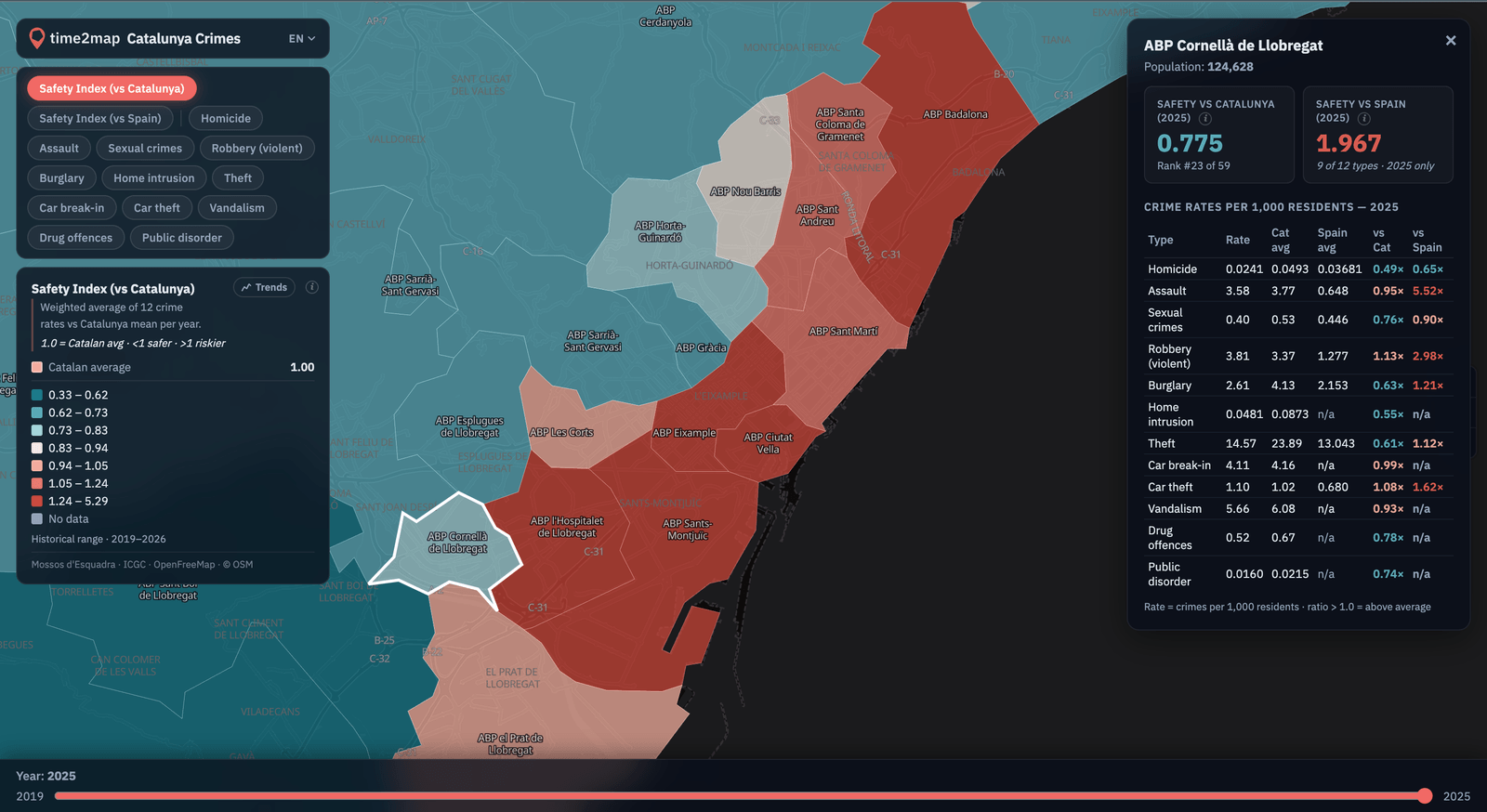
Cornellà de Llobregat is one of the safest zones in the metro area
Safety index vs. Catalonia: 0.775, rank 23 of 59. Cornellà consistently comes out among the safest neighborhoods in the Barcelona metropolitan area — a fact that rarely gets attention because it isn't a central district. The subjective feeling matches the numbers.
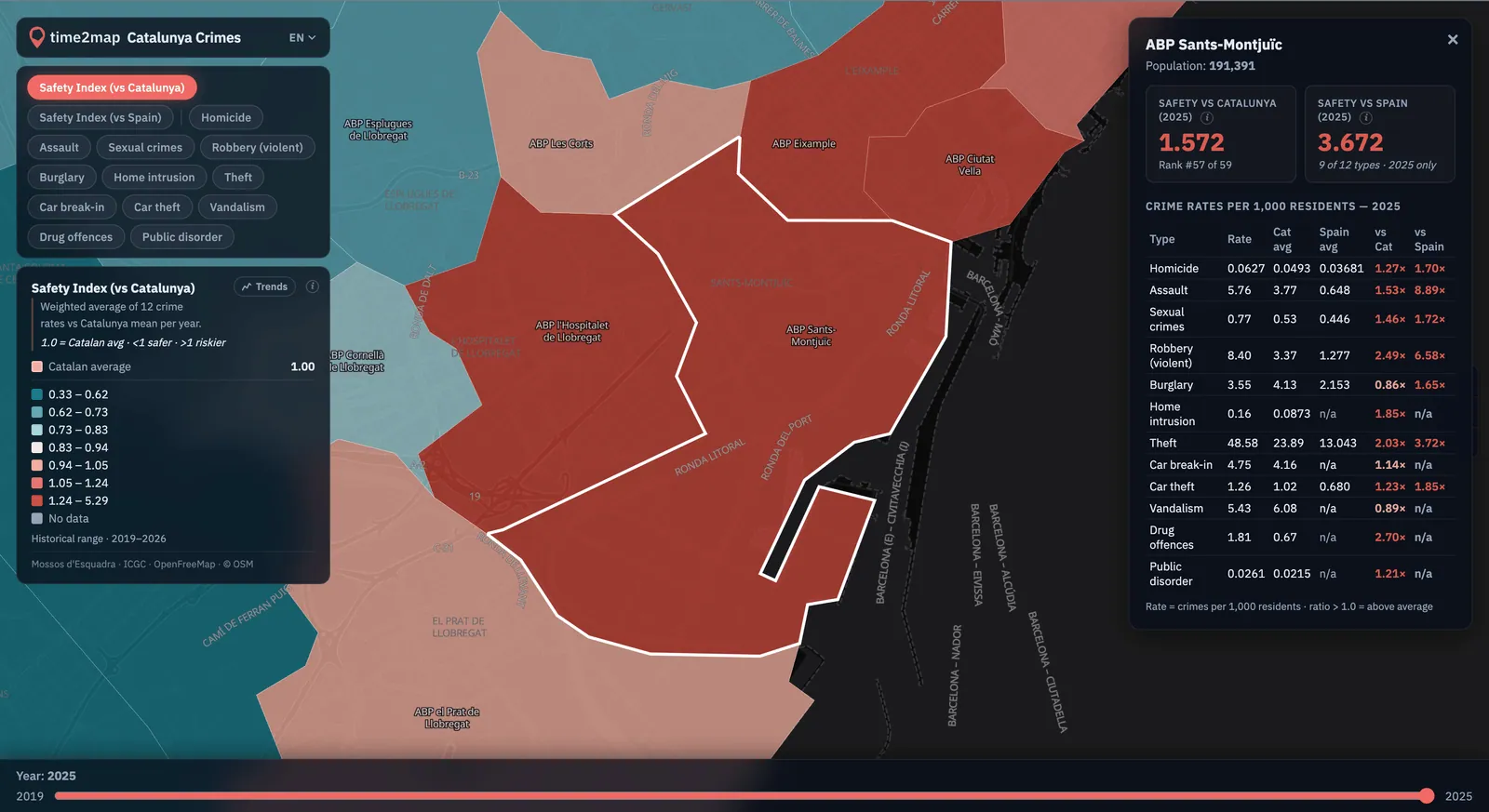
Sants-Montjuïc ranks 57 out of 59 — which surprised me
Safety index vs. Catalonia: 1.672, rank 57 of 59. That puts Sants-Montjuïc near the bottom of the ranking, yet Sants feels safe day-to-day. The likely explanation is that the ABP zone also includes Montjuïc hill, the port, and industrial areas that pull the average up.
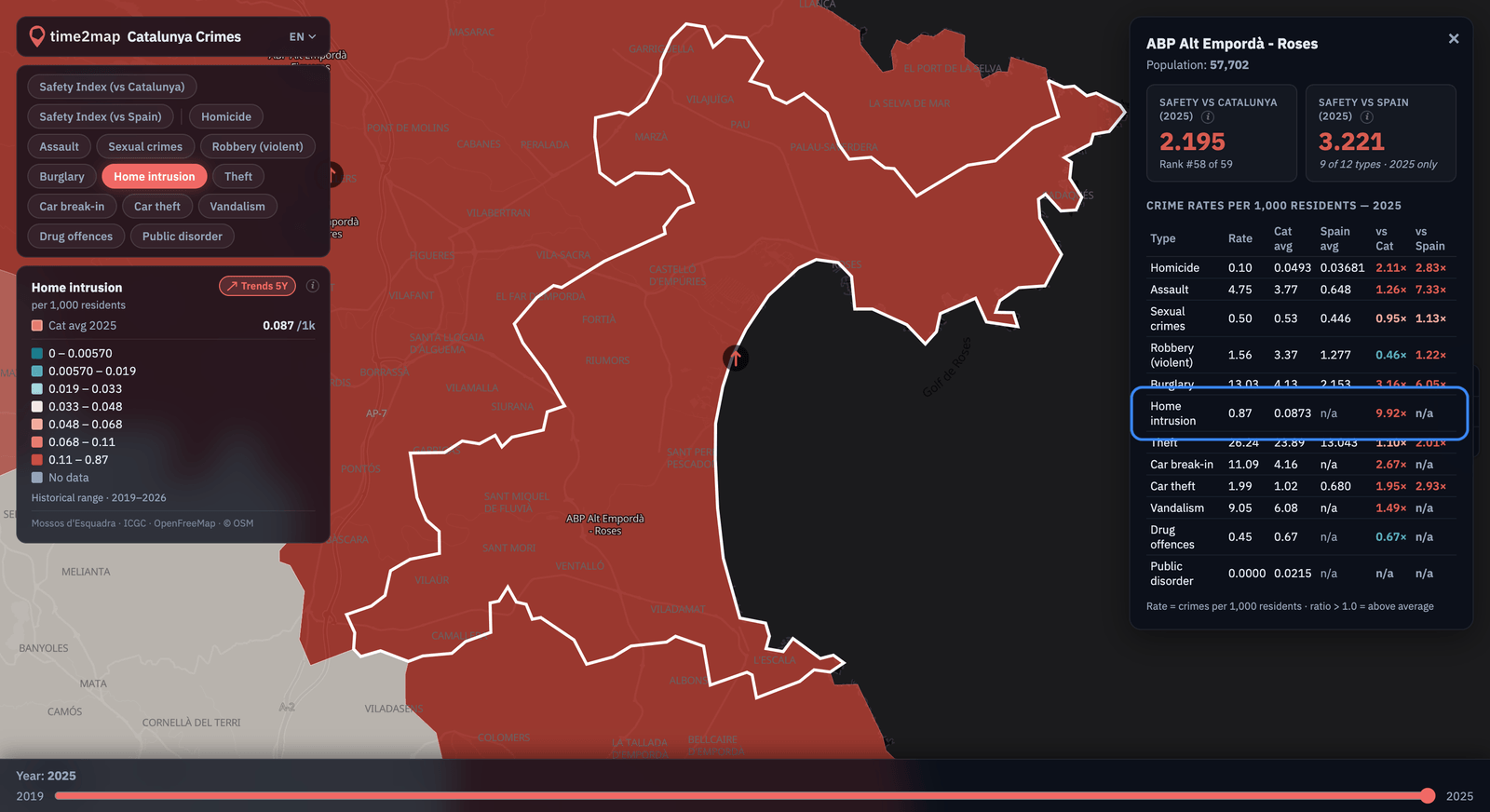
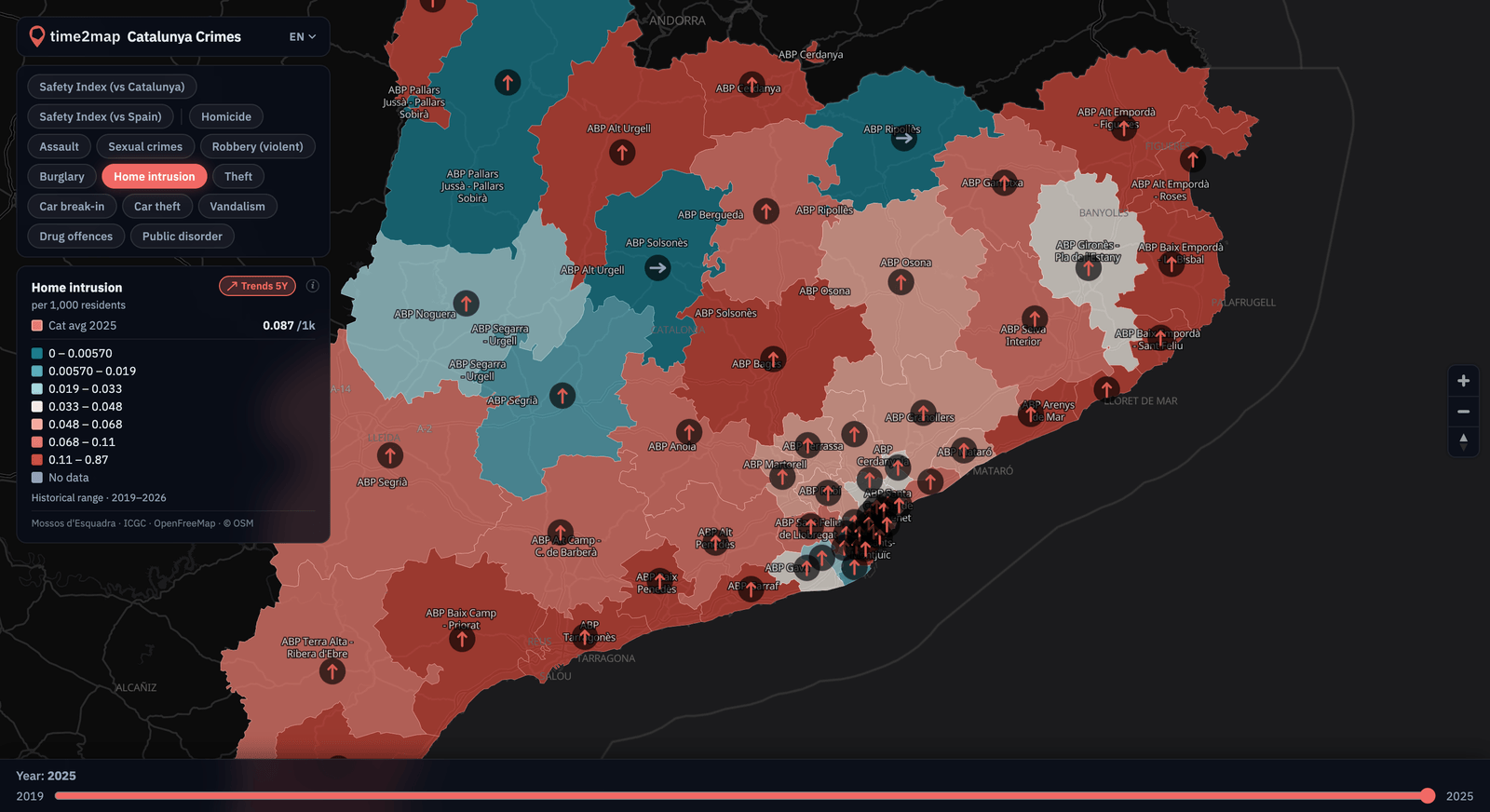
Roses has the highest home intrusion rate in Catalunya
The Alt Empordà – Roses zone recorded the highest home intrusion rate in Catalunya in 2025 — 0.087 per 1,000 residents, ×10 the Catalan average. Seasonal vacancy is likely a driver: empty holiday homes are a well-documented target.
Home intrusion hasn't declined anywhere in five years
Across all 59 ABP zones, the 2019–2025 trend is flat or rising. Not a single zone shows a sustained downward trend over the full period. This isn't isolated spikes, but a consistent pattern across both urban and rural zones.
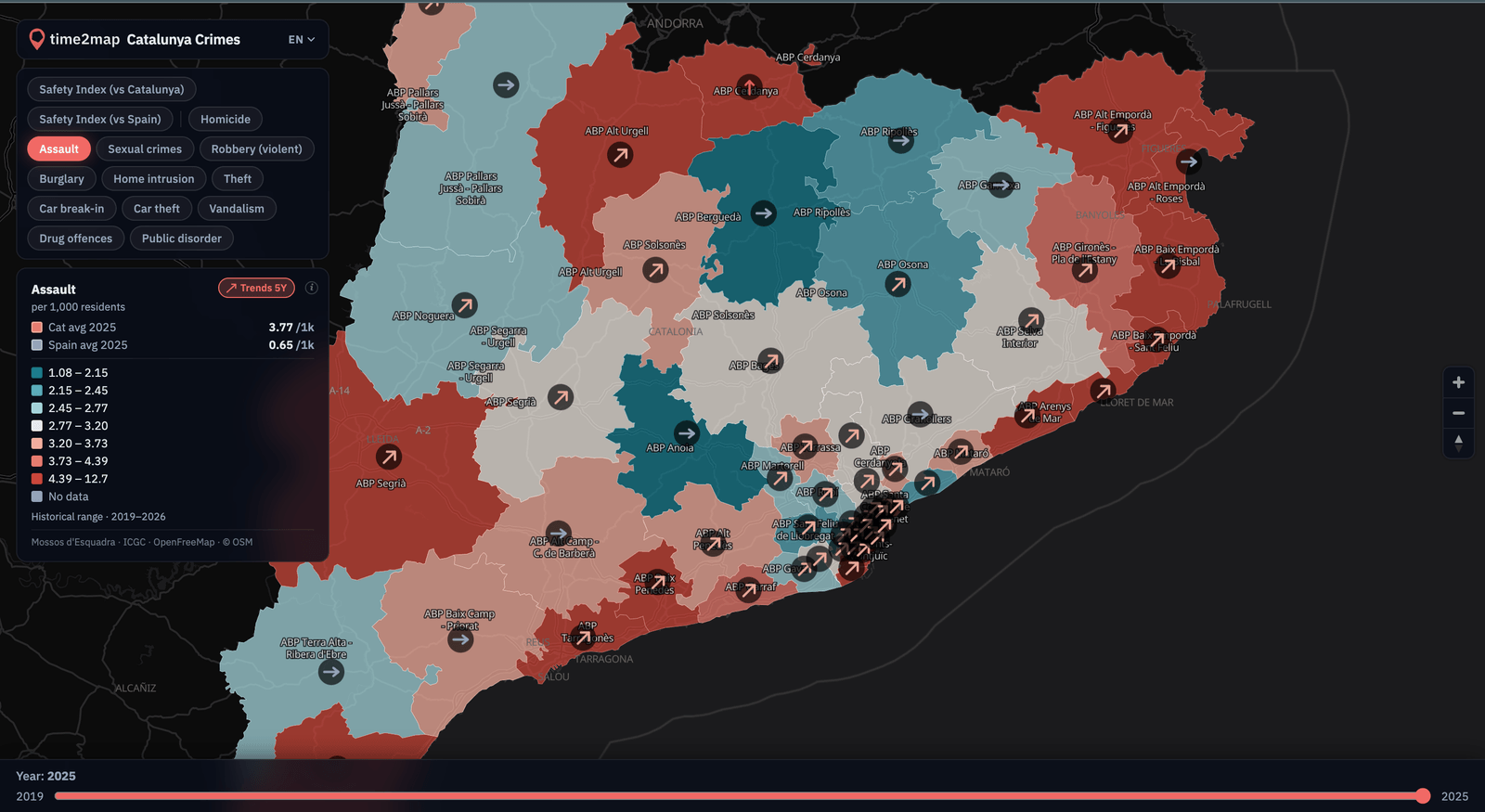
Assault is rising across the entire region
The trend map shows upward arrows across virtually every zone. This is not a city-specific phenomenon: rural and coastal zones are affected as well.
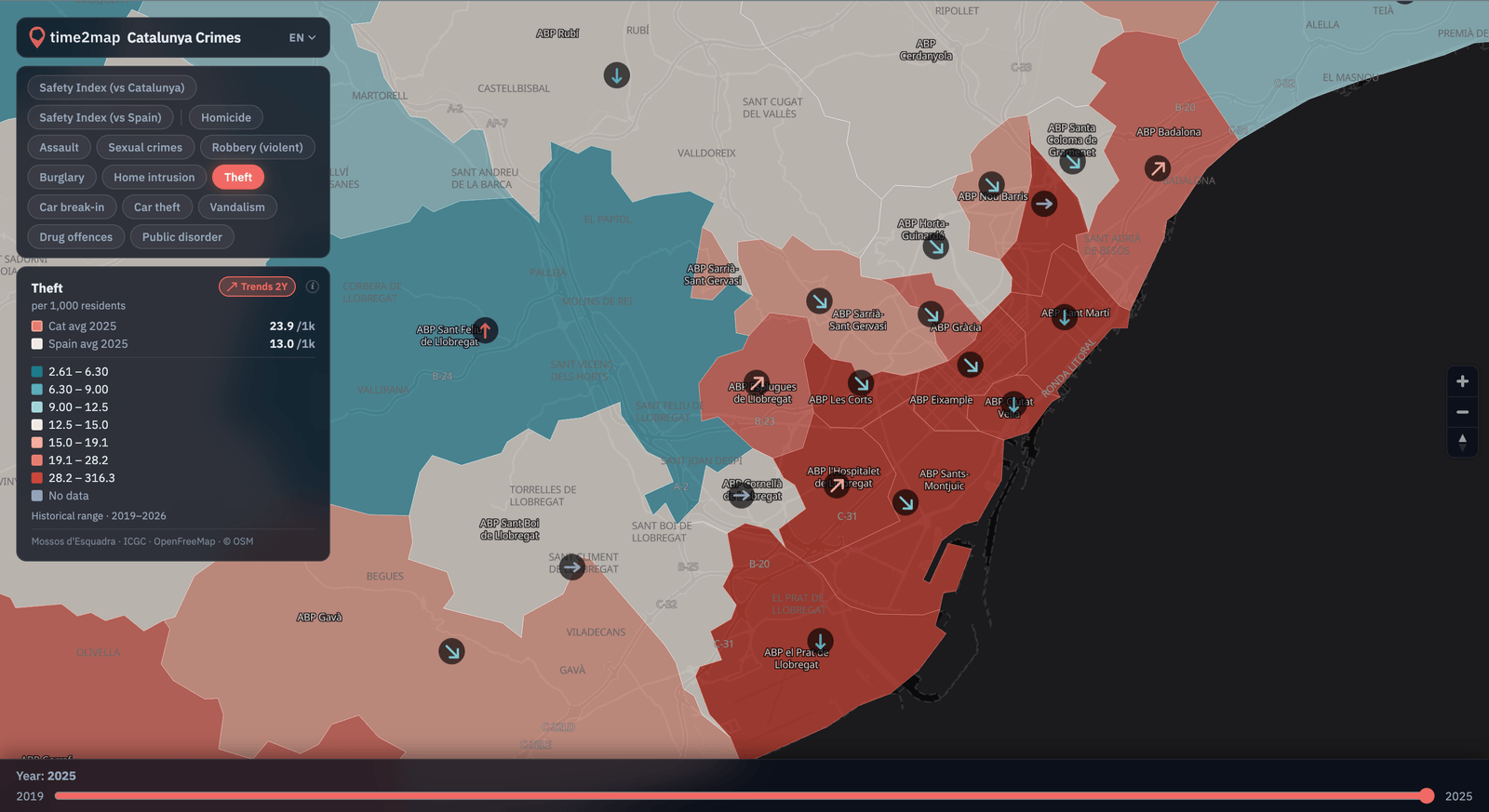
Theft in Barcelona is actually declining
Despite Barcelona's reputation for pickpocketing, theft rates have been falling across most central zones over the last two years. It is a notable counterpoint to the rising assault numbers, although Barcelona's overall indexes remain high.
How the index
was built
- Open data from Mossos d'Esquadra
Crime statistics downloaded from the ICGC viewer — 1,520 vector tiles across every ABP zone. Spanish national averages were parsed from the Ministry of Interior annual report.
- Composite safety index
A weighted mean across 12 crime types, normalised against Catalan and Spanish averages. Homicide, assault, sexual crimes, robbery, and theft are weighted higher than drug offences or public disorder.
A note on limitations: Crime weights are subjective and reflect my priorities for outdoor safety. The Spain comparison covers 9 of 12 crime types for 2025. ABP zones are large areas; a high-crime zone can contain safe and unsafe pockets the data cannot distinguish.
 Connect with me on Linked